A hybrid Artificial Intelligence framework combining Automatic Identification System (AIS) trajectories, meteorological observations, fuzzy logic, and deep learning to estimate maritime collision risk and support navigational decision making. This project represents my first major transition from structural engineering into applied Artificial Intelligence.
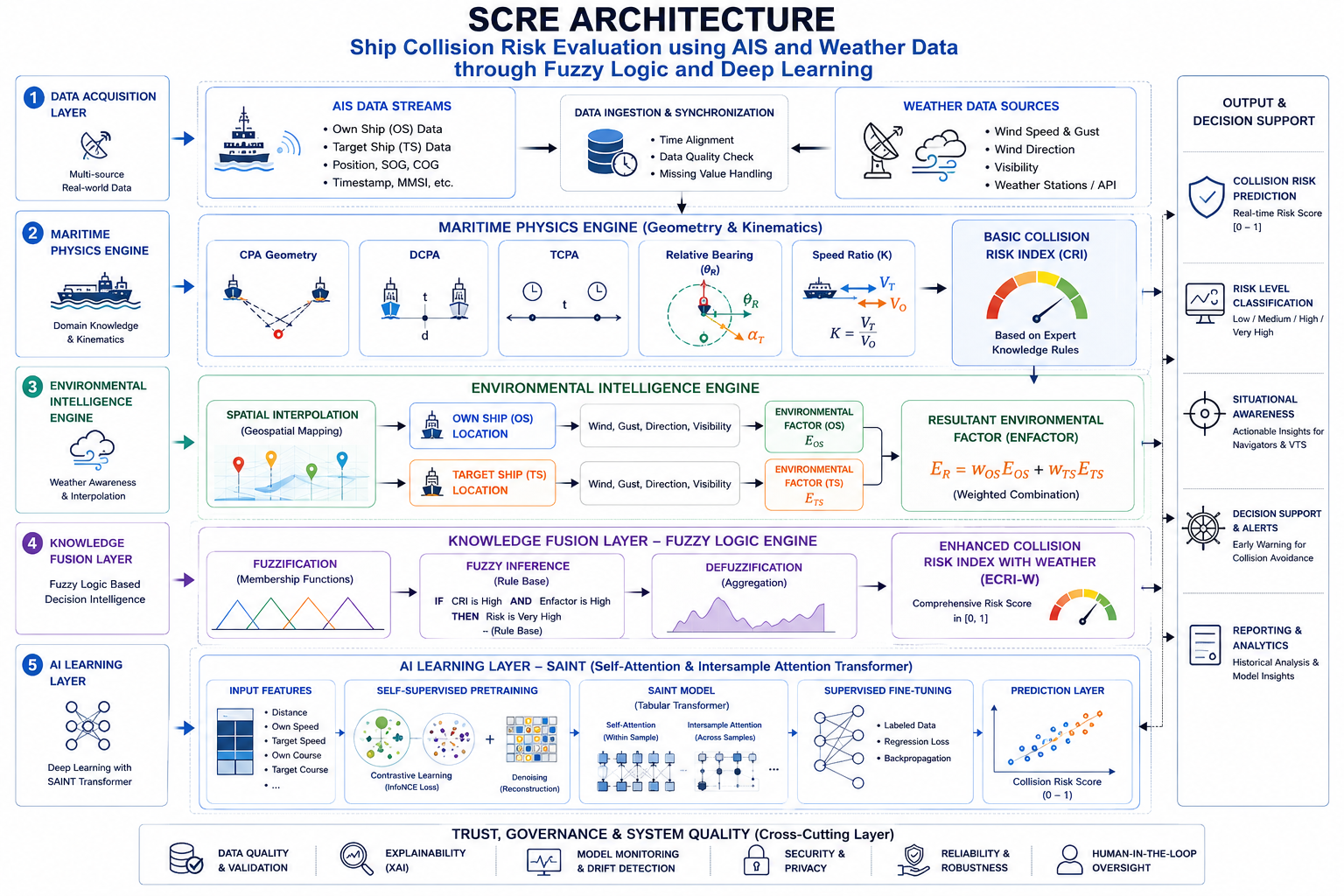
Ship collision remains one of the most significant operational risks in modern maritime transportation. Traditional collision assessment methods rely heavily on deterministic calculations and expert judgement. SCRE investigates whether Artificial Intelligence can improve collision risk estimation by integrating vessel movement, environmental conditions, and uncertainty modelling into a unified predictive framework.
Trajectory analysis using dynamic vessel behaviour.
Environmental conditions integrated with navigational data.
Human-like reasoning under operational uncertainty.
Learning complex collision risk relationships from data.
Combines symbolic reasoning with data-driven learning.
Risk prediction for navigational safety.
Designed for practical maritime deployment.
Interpretable fuzzy reasoning complements neural models.
Ship Collision Risk Assessment using AIS Trajectories and Weather Information through Hybrid Artificial Intelligence. Published in Ocean Engineering (2024)
Place trajectory visualisations, collision scenarios, architecture diagrams, prediction outputs, and screenshots here.